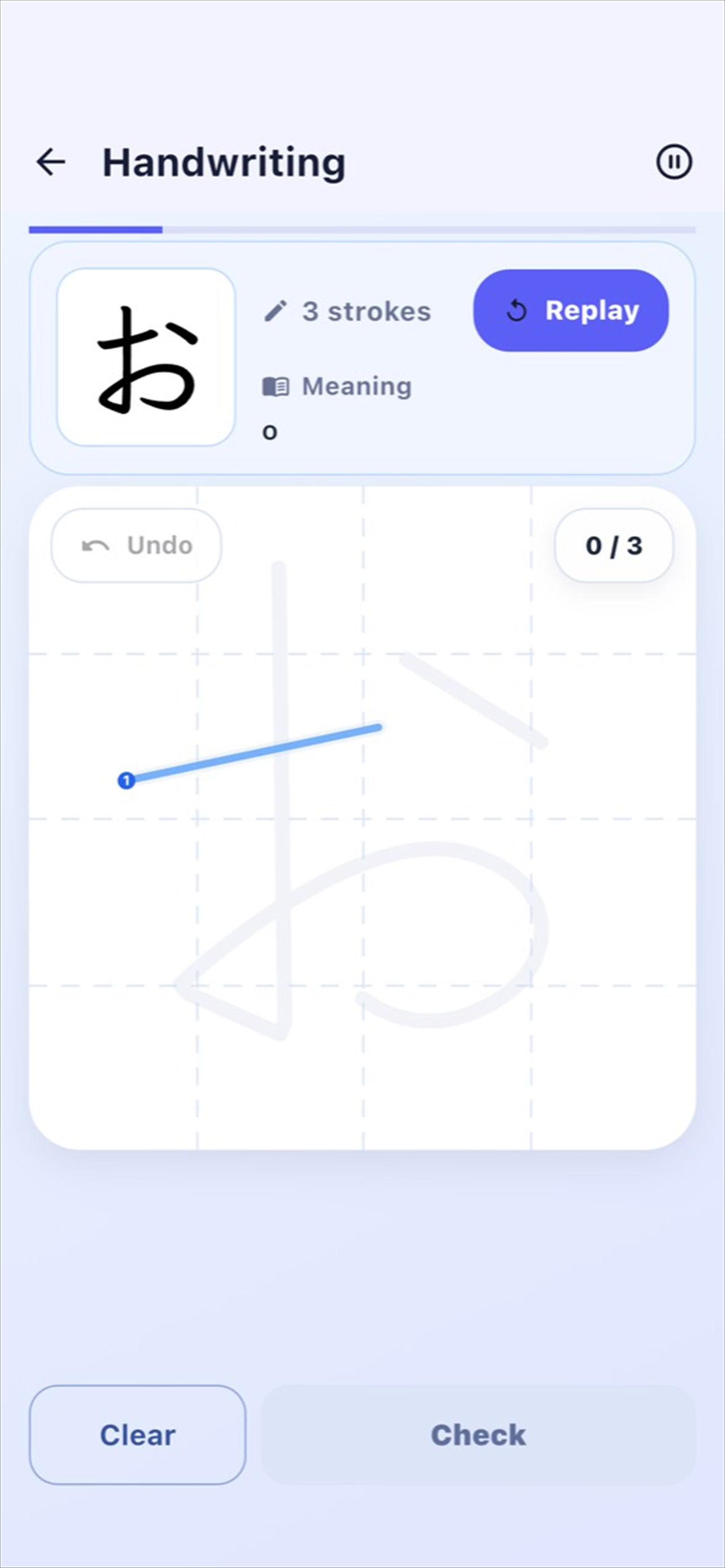
YoruLearn is a Japanese kanji practice app for iPhone and iPad that helps you practise writing characters and review what you learn. In supported handwriting practice, write on the screen and check your attempt using recognition-based feedback. Learn a character’s meaning and readings, use the stroke-order reference, and return to difficult items. Try the free worksheet below before deciding whether the app suits you.
Study paths include 漢字練習 (kanji practice), 語彙復習 (vocabulary review), 文法トレーニング (grammar training), 毎日学習 (daily study), and 間違い復習 (review of mistakes).
Choose a character, review its shape and stroke-order reference, then write it in the practice area and check your attempt. YoruLearn uses on-device Japanese handwriting recognition as part of its evaluation. The practice can offer different levels of guidance as you move towards writing from memory.
The Japanese recognition model must first be downloaded from Google. Once downloaded, recognition can work offline. Recognition is not perfect: a correct-looking attempt may be missed, and a recognised character does not by itself prove every stroke was written in the correct order. Compare your writing with the reference and try again when needed.
Example of guided handwriting practice in YoruLearn, shown with hiragana. The exact screen and available guidance may vary.
Free printable kanji practice
No app is needed. Use your browser’s Print command to print this worksheet. Copy each character into the first square, cover the model, and write it from memory in the next two. Compare, circle the hardest one, and repeat tomorrow.
Readings become more useful when attached to words and level-appropriate kanji.
Review readings alongside character entries.
Stroke order
A repeatable writing sequence makes handwriting practice easier to verify.
Play the stroke-order animation before writing.
JLPT scope
A clear study boundary stops your review list from growing without direction.
Browse N5 through N1 kanji by level.
Return review
Recognition fades without retrieval and a way to revisit mistakes.
Use review flows to revisit weak items.
A character can feel familiar while its reading, stroke sequence, or vocabulary use is still weak. Treating those as separate checkpoints gives you a practical next action instead of rereading the same list.
How to Practise One Kanji in YoruLearn
Choose a small set from your current JLPT level, such as the JLPT N5 kanji list.
Search the character and read its core meaning, onyomi, kunyomi, and stroke count.
Play the stroke-order animation, then write the character from memory before checking it again.
Attach at least one example word to the character so the reading has a context.
Return to missed characters in review instead of restarting the full list every day.
For example, you might begin with 日, confirm that it can mean day or sun, review readings such as にち and ひ, then meet it again in a word like 日曜日. This turns one symbol into a usable study unit.
JLPT level is a useful organizing tool, not a reason to ignore words you meet in your own reading. Keep level study structured, but add a character when it repeatedly appears in material you are already using.
5 Common Mistakes When Using a Kanji Practice App
Studying only the English meaning. Add a reading and an example word before moving on.
Watching stroke order without writing. Animation is a reference; recall and writing are the active steps.
Adding too many new characters at once. A smaller set makes missed items visible and review sustainable.
Using JLPT levels as a memorisation race. Recognition, reading, and writing improve at different speeds.
Never revisiting errors. Let missed kanji determine tomorrow’s review instead of repeatedly choosing only familiar characters.
Frequently Asked Questions
Does an app check handwritten kanji?
YoruLearn uses handwriting recognition as part of its evaluation in supported practice. Recognition can be mistaken; compare your attempt with the reference and try again.
Can I practise kanji handwriting offline?
The Japanese recognition model must first be downloaded. Recognition can then work offline; other app features may have different connection requirements.
Is handwriting practice free?
Use the worksheet on this page without an app. YoruLearn has free and Premium features; check the app and App Store listing for current access and prices.
Is YoruLearn available for iPhone and iPad?
YoruLearn is available through the Apple App Store. Check the listing for current device and operating-system requirements.
What does a kanji practice app help you practise?
It helps you connect a character’s meaning, readings, stroke order, writing, vocabulary, and review rather than studying only one of those pieces.
Can beginners use a Japanese kanji practice app?
Yes. Begin with a small JLPT N5 set and use character entries plus short words before increasing volume.
Why does stroke order matter for kanji?
Stroke order gives you a consistent sequence to follow and makes your own handwriting practice easier to repeat and compare.
How should I use JLPT levels in kanji study?
Use a level to choose a manageable scope, then let missed characters return in review. Do not try to memorise a whole level in one pass.
Can I search a kanji before practising it?
Yes. Use the YoruLearn Kanji Dictionary to search by character, English meaning, reading, or level and play a stroke-order animation.
Build a Kanji Practice Habit with YoruLearn
Turn a reference page into a practice loop: search a character, check its stroke-order reference, write it, and revisit difficult items. The App Store listing shows current pricing and availability.
This page describes the current YoruLearn study flow and links to the live iOS listing. JLPT levels are used as study organization rather than as an official fixed kanji syllabus.